Every now and then (when I have time..) I do a bit of work on what's going to become my home automation system. At the moment it's pretty basic, it's simply events going over a message broker that small stubs of code react to. Most of it runs on my raspberry pi and a few jeenodes (atmega328 + hoperf rfm12b radio) as wireless sensors.
Everything connects to a simple message broker built on ZeroMQ - and I love it! ZeroMQ is so great to work with, it takes most of the hassle of network socket programming away leaving you to concentrate on what really matters. There is no daemons to deal with (as with most other message buses), it's lightning fast, but doesn't really handle persistant messaging.
At the core of the system I have this running on my raspberry pi:
# Router / Central hub for home automation.
# Receives events and distributes via pub/sub

zmq = require 'zmq'

inputPort = 'tcp://*:8888'
outputPort = 'tcp://*:9999'

# Pull socket for incoming (push/pull), pub for outgoing (pub/sub)
input = zmq.socket 'pull'
output = zmq.socket 'pub'

input.identity = 'brokerin' + process.pid;
output.identity = 'brokerout' + process.pid;

output.bind outputPort, (err) ->
    throw err if err
    console.log "Publisher listening on #{outputPort}"

input.bind inputPort, (err) ->
    throw err if err
    console.log "Pull listening on #{inputPort}"

input.on 'message', (data) ->
    try
        jdata = JSON.parse data
        if not jdata.event?
            jdata.event = "unknown"

        strData = JSON.stringify jdata
        console.log "Relaying packet of type: #{jdata.event} >> #{strData}"
        output.send [jdata.event, strData]

    catch error
        console.log "Invalid data: #{error}"
        console.log data.toString()

process.on 'SIGINT', () ->
    input.close()
    output.close()
It's very simple - just two ZeroMQ sockets - one running in a push/pull configuration, another running in a pub/sub configuration. A relay for my sensor nodes will connect to it and push it JSON formated data from the different sensors located in my apartment.
{
    "nodeid": 2,
    "temperature": 2.19,
    "voltage": 335,
    "counter": 1215,
    "event": "sensor",
    "timestamp": "2012-09-24T15:49:28.369Z",
    "location": "refrigerator"
},
{
    "nodeid": 3,
    "temperature": 23.5,
    "voltage": 369,
    "counter": 20,
    "event": "sensor",
    "timestamp": "2012-09-24T15:52:08.450Z",
    "location": "livingroom-bookshelf"
}
The broker will relay events such as these, the two examples are wireless sensor nodes located in my refrigerator (currently holding 2.19C and battery voltage of 3.35v) and the other one in my livingroom bookshelf (2.19C and 3.69v). The broker will receive these (and others), and send them out to subscribers of sensor events. It makes it really easy to make something that reacts to the temperature, you can connect to the broker and subscribe to sensor events in 2-3 lines of code in most languages. Example:
sub = (require 'zmq').socket 'sub'

sub.connect 'tcp://raspberrypi:9999'
sub.subscribe 'sensor'
sub.on 'message', (topic, data) -> console.log "#{topic} => #{data}"
As you can see, it would be very simple to expand this and create something that let me know if a battery of a sensor was running low. Or something that would PID adjust a heating source in the living room. Or something that would warn me if temperature in the fridge was running high.. or.. or.. or.. Beauty of it is that you don't have to think about network stuff like disconnects..
I've made a small program in C# running on my HTPC that registers a few global hotkeys. If I press ctrl-alt-o then a small event will be sent out from the C# program, to the message bus, to everyone that subscribes to "receiver" events. There is a small program that does this and relays the message to a microcontroller, which in turn talks to my Pioneer VSX-2016av surround receiver via the SR bus I talked about in an earlier post. For example, sending events like these to the broker will toggle the power of the surround receiver and turn the volume up 5 steps.
{
    "event": "receiver",
    "action": "power"
},
{
    "event": "receiver",
    "action": "volumeup",
    "count": 5
}
Quick example above, sorry for the camera shake.
It's getting there, now I have sensor data and control over the surround receiver. The next steps will be to expand the available sensor data - I wish to add a DHT22 Humidity sensor and also a light sensor (LDR?) to the sensor nodes soon. And also maybe PIR (passive ir). I also need to add control over power soon (lighting and heating).
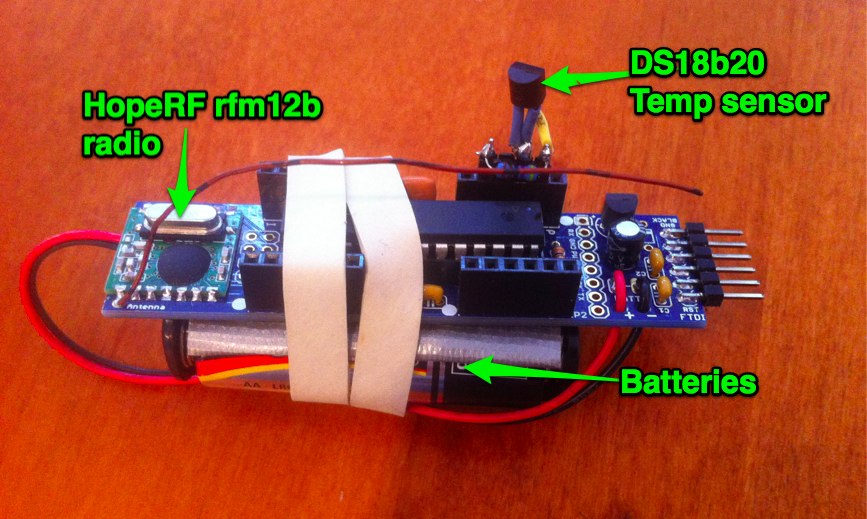
At the moment they are only using a DS18B20 temp sensor. When I have all the components in place I'll make a small PCB with room for all the components, the radio and a smaller atmel microcontroller. Currently they take up a bit more space than needed.
2 comments
Hey, I am very interested in how this works and just wondered if you could explain a bit more of the hardware..
as I see it, your Pi is listening on Port 8888 for data.. you have a jeenode which looks as if it is connected to the serial port on the pi?
So are you listening on the serial port on the pi and then sending serial data to port 8888 which this other program picks up?
I would like to how I get from a temperature reading in my micro which I have formatted to JSON to the actual TCP stuff on the Pi?
Hello :)
So, there are a few steps to this and I'll try to explain.
On the hardware side there is a jeenode connected to uart on the raspberry pi.
(Also PWR is connected to 5v out on raspberry pi, and ground to ground).
Have a look at: http://elinux.org/RPi_Low-l...
GPIO14 and 15 double as TX and RX pins.
There are some more steps you need to do to get this working, as the PI
has a terminal running on serial per default, see here how to disable it:
http://www.irrational.net/2...
If you now configure the jeenode/microcontroller to transmit readings via
serial/uart and open the serial device on the PI you should be able to read them.
You can use screen to manually read this (for speed 9600 baud): screen /dev/ttyAMA0 9600
I then have a node/coffeescript program that reads this and relays it to a "message broker"
via ZeroMQ. https://github.com/stianeik...
There is a few other things going on in the script as the microcontroller also controls my home cinema receiver.
The "message broker" https://github.com/stianeik...
then relays these messages to all other services that subscribe to them.
I use ZeroMQ ( http://www.zeromq.org/ ) for this. ZeroMQ is kinda an abstraction layer on top of TCP/IP
that give you message queue like functionality, it also takes away all the boring stuff of networking
(handling disconnects, reconnects, packages, etc..). In retrospect I think I would have been
better served using Redis, as it would have made it easier to keep global state.
Hope this is of any help :)